



How to Check Your Tire Pressure at a Gas Station
This guide is for drivers who want to learn how to check and read their tire pressure at a gas station, whether you're a beginner or just need a refresher. Proper tire pressure is essential for safety, fuel efficiency, and tire longevity. Maintaining the correct tire pressure not only keeps you and your passengers safe, but it also helps your vehicle perform at its best and saves you money in the long run.
Checking your tire pressure at a gas station is easy, affordable, and convenient. This article will guide you through how to read tire pressure at a gas station and walk you through each step of the process, so you can confidently maintain your tires wherever you are.
Before we dive into the step-by-step instructions, let’s clarify a couple of key terms you’ll encounter:
PSI stands for Pounds Per Square Inch, which is the standard measurement for tire pressure.
Cold tires refer to tires that have not been driven on for at least 3 to 4 hours. Tire pressure should be checked when the tires are cold, ideally after the vehicle has not been driven for at least 3 to 4 hours. This ensures the most accurate reading, as driving heats up the tires and can increase the pressure reading.
Let’s walk through the process step by step.
Step-by-Step Guide to Checking Tire Pressure at a Gas Station
Here are the 9 simple steps to checking your tire pressure at a gas station:
-
Step 1: Gather Your Tools
Bring a tire pressure gauge with you, or use the one provided at the gas station. You can use a handheld gauge, a free-standing pressure gauge, or the pressure gauge on the handle of an older air compressor to measure your tire's pressure.
-
Step 2: Park Your Vehicle
Park your vehicle close to the air compressor at the gas station, making sure you have easy access to all four tires.
-
Step 3: Check the Recommended Pressure
The manufacturer's recommended tire pressure settings can usually be found on a panel or sticker near the driver-side door. Refer to this information before checking or adjusting your tire pressure.
-
Step 4: Remove Valve Caps
To check tire pressure, first remove the valve stem cap from the tire. Keep the caps in a safe place so you can replace them after checking.
-
Step 5: Test the Air Pump
If you’re using the gas station’s air compressor, test it briefly to ensure it’s working properly before attaching it to your tire.
-
Step 6: Check and Adjust Tire Pressure
Attach the pressure gauge or air hose to the tire’s valve stem. Confirm the hose is securely attached to the valve stem to prevent air leaks during pressure measurement. Read the pressure on the gauge. After checking the pressure, if the tire is low, you can add air at the gas station using the air compressor.
-
Step 7: Repeat for All Tires
Repeat the process for each tire, including the spare if your vehicle has one.
-
Step 8: Recheck and Finalize
After inflating, recheck the pressure to ensure it matches the recommended PSI. Replace the valve caps when finished.
-
Step 9: Maintain Regular Checks
Make it a habit to check your tire pressure at least once every two months, or more often if you drive frequently.

Now that you know how to check your tire pressure, here are some common questions and extra tips.
Why Checking Tire Pressure Matters
Keeping your tires at the correct pressure is important for several reasons:
Safety: Properly inflated tires provide better handling and reduce the risk of blowouts.
Fuel Efficiency: Correct tire pressure helps your car use fuel more efficiently, saving you money at the pump.
Even Tire Wear: Maintaining the right pressure ensures your tires wear evenly, extending their lifespan.
Performance: Well-inflated tires improve your vehicle’s overall performance and ride comfort.
If the pressure level is set properly, your car tires will wear out more evenly. This means that their performance will be more consistent throughout the lifespan of the tires, and it will dramatically improve the fuel efficiency of your car. The experience of driving a car with better tires is absolutely mind-blowing, especially if you have been driving with properly pressurized tires for quite some time now.
There are many reasons why you should be aware of the current state of your tires. It is very unsafe to drive with de-pressurized tires. So, it is highly recommended to check up whenever possible. In most cases, it's advisable to check the pressure of your tires at least once every two months if not more, depending on how often you use your vehicle.
Gas Station Equipment for Tire Pressure
On the other hand, some of the most popular places where you can check the pressure of your tires are definitely gas stations and service stations. Whenever you check the pressure of your tires at a gas station, you're most likely to find special gauges, which are available for this exact purpose. Most gas stations either have a dedicated pressure gauge or a pressure gauge attached to the handle of the air compressor. At first, checking your tires with such gauges might seem intimidating. However, they are easier to use than you might think.

Most gas stations will even have detailed instructions that will walk you through each step of the process. In addition to that, you can always ask a service staff member to help you out check your tire with the gauges if you are really confused and don't know what to do.
Having said that, it is worth noting that this is a very simple operation that can be performed by pretty much any driver, including beginners.
All you really need is a tire pressure gauge and an air compressor (provided by the gas station) to make adjustments. It might be useful to track the measurements of your pressure over time, you can bring a pen and a notepad along for the ride. If you're the tech-driven type, you can simply save your measurements on your phone and make it a lot easier.
There are tons of different types of pressure gauges available at gas stations. Some of them are innovative and modern, featuring digital metering and displays. However, most stations still use old-school gauges.
You can use a handheld gauge, a free-standing pressure gauge, or the pressure gauge on the handle of an older air compressor to measure your tire's pressure.

These are still quite reliable and it really is all about your personal preferences. You can find air compressors at most gas stations as well, and the great thing is that they are super affordable. Using them costs anywhere from a few cents to a dollar, depending on where you are.
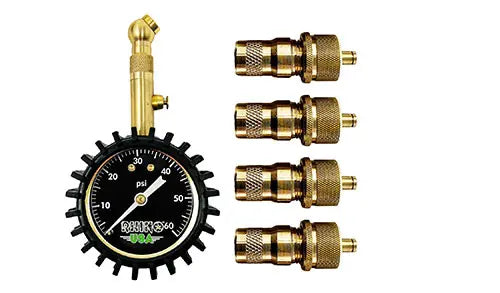
If you're like me, you might consider buying your own personal tire pressure gauge. This is a great tool to have in your vehicle and because it's so small, you can store it pretty much anywhere. Click here to view our line of tire gauges!
Types of Tire Pressure Gauges
Here’s a quick comparison of the types of gauges you might encounter:
Type |
Features |
Pros |
Cons |
|---|---|---|---|
Handheld Gauge |
Small, portable, analog or digital |
Easy to carry, accurate |
Must bring your own |
Free-standing Gauge |
Stationary, often at gas stations |
No need to bring your own |
May be less accurate if old |
Air Compressor Gauge |
Built into air pump handle at gas stations |
Convenient, dual function |
May be harder to read |
Understanding Tire Pressure Recommendations
In order to make sure that you get the most accurate readings, try to make sure that your tires aren't really hot. If possible, you should also have the manufacturer's recommended pressure level (PSI) at hand for reference. If you don't have paper documents handy, you might be able to easily google this information and look it up from your computer. Of course, the vast majority of tires available on the market (if not all of them) actually would display a PSI indication, showing the max pressure recommended.

Avoid using the maximum PSI listed on the tire sidewall; instead, use the recommended operating PSI. There are many people who prefer to slightly under-pressurize their cars in relation to the recommended maximum levels. This is because the air might expand as you drive and the tires heat up, therefore potentially increasing the pressure of the tires. This is something that's particularly common throughout summertime, and in particularly hot areas.

Frequently Asked Questions
What is the best tire pressure gauge?
The best tire pressure gauge is the 100psi and 200psi Rhino USA tire pressure gauges. They are certified ANSI B40.1 accurate and come with a premium "no-leak" braided hose and interchangeable solid brass chucks. Rhino USA makes the best tire pressure gauges and to top it off, they all come with a lifetime warranty.
Are digital tire pressure gauges accurate?
A properly calibrated digital tire pressure gauge can be one of the most accurate ways to measure your tire pressure. Rhino USA's digital tire pressure gauge is one of the most accurate tire pressure gauges in the industry, and it features a backlit LCD display and a lighted nozzle for fast, accurate tire pressure readings.
Conclusion
In conclusion, keep in mind that checking the pressure of your tires is very important. You should never underestimate the safety of yourself and your family, especially if you are getting ready for long car trips or if you use your vehicle on a day-to-day basis.
The more often you use your car, the more often you should consider checking the pressure of your tires to make sure that you do not run into any unexpected issues. Regular checks help you avoid the hassle of a flat tire and improve the longevity of your tires, not to mention the performance of your vehicle.
Thank you for taking your time to read our article. As mentioned above, we sell a line of high quality Tire Pressure Gauges designed for the on-the-go experience. Much better than having to stop at a Gas Station for a quick PSI reading. Get your own gauge today by clicking here.

- Choosing a selection results in a full page refresh.