



E-Track is a heavy-gauge steel cargo control rail with universal slots that accept a wide range of tie-down fittings. If you've ever opened the back of a moving van and seen those long metal slotted rails running along the walls, that's E-Track. It's the system the freight industry standardized on decades ago, and it's the same system enclosed trailers, work vans, and serious haulers use to lock heavy loads down without guessing.
This guide answers the basic question: what is E-Track, what does it do, and why is it the most flexible tie-down system you can install in a trailer, van, or truck bed. American family operated, lifetime warranty on every Rhino USA E-Track piece.
What Is E-Track?
E-Track, also known as logistic track, is a heavy-gauge steel rail with evenly spaced slots that accepts a wide range of fittings and accessories. You bolt the rails to the walls or floor of a trailer, van, or pickup bed. Then you snap your strap fittings, hooks, or load bars into the slots wherever you need them. That's the whole concept: a rail full of universal anchor points, instead of a few fixed D-rings welded in two places.
The point is flexibility. One trailer can haul a motorcycle one weekend and lawn equipment the next, and the tie-down points move with the load.
Horizontal E-Track vs Vertical E-Track
Two main configurations of E-Track rails: horizontal and vertical. Most professional setups combine both.
- Horizontal E-Track runs parallel to the trailer floor and is the most common configuration. The slots run perpendicular to the rail itself and provide more anchor points per foot for securing large equipment. Horizontal rails are typically installed in sections or the full length of a trailer wall.
- Vertical E-Track runs up and down the trailer walls. It's used for taller cargo, stacked boxes, or any load where you need to anchor at multiple heights.
A run of horizontal E-Track at waist height plus a vertical rail in each corner gives you anchor points at every angle.

How E-Track Rails Work
E-Track rails are available in lengths from 2 to 10 feet and are mounted to the interior walls or floors of vehicles, vans, and trailers. The slots accept a wide range of E-Track fittings: rope tie-offs, ratchet hooks, O-rings, D-rings, shoring beam ends, and quick-release fittings that let accessories snap in and out without tools.
Once you have rails up, the system speaks for itself. Drop a fitting into the slot, twist or push to lock, and you have a rated anchor point right where you need it.
Common E-Track Accessories
The accessory ecosystem is the real reason cargo control pros use E-Track.
- E-Track Ratchet Straps. Heavy-duty polyester webbing tie-down straps with E-Track end fittings instead of standard hooks. Used to secure cargo against trailer walls or to the floor.
- E-Track Cam Buckle Straps. Same fitting style with a cam buckle for medium loads where quick on and off matters more than max tension.
- Rope Tie-Offs. Allow traditional ratchet straps with hooks to be compatible with E-Track rails, providing versatility without buying new straps.
- O-rings, D-rings, and J-hooks. Permanent or removable anchor points for short straps and bungees. The E-Track O-Ring Anchors (10-Pack) snap into any standard E-Track slot.
- Shoring Beams. Adjustable metal bars that lock into tracks on opposite walls to prevent cargo from shifting or to create a second storage level. Combined with plywood, shoring beams build custom shelving and multi-level decking for stacking heavy loads.
- Load Bars. Designed to provide load stabilization from front to rear of the trailer, preventing cargo from tipping over during transport.
E-Track straps come in two main types: ratchet and cam buckle, both made from heavy-duty polyester tie-down webbing for UV and abrasion resistance.
Retractable E-Track Straps: The Time-Saver
Traditional ratchet straps work but tangle, snag, and leave a pile of loose webbing in the corner of the trailer. Retractable E-Track straps fix all three.
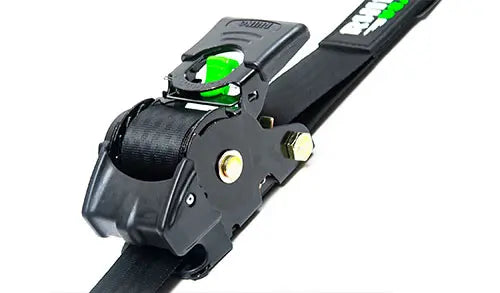
Our 2" x 10' Retractable E-Track Ratchet Straps auto-retract back into the housing the moment you release tension. No more loose webbing in the trailer, no more wrestling tangled straps before every load. 3,033 lb break strength per strap, soft loops included, E-Track end fittings built in.
For frequent haulers and full-time fleet use, retractables save real time on every load.

Where to Install E-Track
E-Track is the right answer in any vehicle that hauls a variety of cargo:
- Enclosed trailers for motorcycles, side-by-sides, and lawn equipment
- Cargo vans and box trucks
- Pickup beds with side rails
- Garages for tool wall organization
Anywhere you need flexible anchor points and you don't want to commit to permanent welded D-rings, E-Track is the answer.
How to Install E-Track Rails
Before installing E-Track rails, plan the layout based on the type of cargo being transported and measure and mark the installation points accurately. The location matters: most haulers run a horizontal rail at about 12 to 18 inches off the deck for low-load anchor points, and another at waist height for taller loads.
Use the right fasteners for your wall material:
- Self-tapping screws for fastening to metal studs in steel-walled trailers
- Wood screws for wooden surfaces
- 1/4" hex bolts with washers and lock nuts for heavy-duty applications where the rail will see repeated heavy loads
Drill through the rail's mounting holes into the trailer wall studs. Use metal screws for metal frames and wood screws for wooden structures. Don't sink fasteners between studs into thin sheet metal. The rail's strength comes from the framing behind it.
You can install E-Track horizontally, vertically, or in a combination of both, depending on the cargo securing needs.

How Strong Is E-Track?
Properly installed E-Track rails can provide up to 2,000 lbs of strength per anchor point. That number assumes you've fastened to structural framing. Sheet metal alone won't hold heavy loads. Always refer to your trailer or van's owner's manual for weight limitations specific to the wall construction.
The strength rating is per fitting in the slot, not per rail. A 10-foot horizontal rail full of fittings can hold heavy loads from multiple anchor points in different configurations.
Why Rhino USA's E-Track System
Our E-Track lineup is built for haulers, riders, and pros who care about doing it once and doing it right. Every component is American family operated and backed by our lifetime warranty.
- 5FT E-Track Tie-Down Rails, heavy-gauge steel rails in 5-foot stocked lengths, the most common install size.
- Ultimate E-Track Tie-Down Kit, rails, straps, and fittings in one complete bundle for a first-time install.
- E-Track Ratchet Tie-Down Straps (4-Pack), fixed-length traditional straps with E-Track fittings.
- 2" x 10' Retractable E-Track Ratchet Straps, retractable design that saves time on every load and eliminates the slack-strap mess. 3,033 lb break strength.
- E-Track O-Ring Anchors (10-Pack), drop-in O-ring anchors for short straps and bungees.
For truck-bed haulers, the Bed-Mounted Retractable Ratchet Straps (Ford Trucks) integrate directly into the bed for a permanent, retractable, no-snag setup.
FAQ
What does E-Track do?
E-Track gives you a rail of universal anchor points so you can tie down cargo at any spot along the rail with the right fitting. Replaces a few fixed D-rings with dozens of flexible attachment points.
What are the benefits of using E-Track?
Flexibility, repeatability, and safety. You can secure any load configuration using the same rails. Save time on every load. Save money by not needing dozens of fixed anchor points.
Are E-Tracks worth it?
For anyone who hauls cargo more than a few times a year, yes. The trailer walls become a working tool instead of dead space.
How much weight is E-Track rated for?
Up to 2,000 lbs per anchor point when properly installed into structural framing.
What's stronger, E-Track or L-Track?
L-Track is lighter and used in aviation and motorsport applications. E-Track is heavier and rated for higher loads in cargo applications. For trailers and vans, E-Track is the standard.
Are all E-Tracks universal?
The slot pattern is industry-standard, so most fittings from any manufacturer will fit any E-Track rail. Always check the rated capacity before mixing brands on a heavy load.
What's the best way to install E-Track?
Mount horizontally to wall studs at 18 inches and 36 inches off the deck, using self-tapping screws into metal studs or 1/4" hex bolts into framing for heavy-duty use. Drill through the rail's mounting holes into structural framing, not bare sheet metal.
Should I use retractable or traditional E-Track straps?
Retractable straps save time on every load and eliminate the loose-webbing mess. Traditional straps work fine but require more setup and tend to tangle in storage. For frequent haulers, retractables pay for themselves in saved time.
Can I install E-Track in a pickup bed?
Yes. E-Track rails mount to the bed sides or the bed floor with the right fasteners. For Ford truck owners, the bed-mounted retractable system is a no-drill option that integrates directly into the bed rails.
Do I need horizontal or vertical E-Track?
Both, in most setups. Horizontal rails at waist height handle most cargo. Vertical rails in corners give you anchor points at multiple heights for stacked or tall loads.
How many E-Track straps do I need?
At minimum four, one for each corner of a typical load. Six to eight is better for variety and redundancy on heavier or oddly shaped cargo.
Related Articles
- Best Heavy-Duty Ratchet Straps
- Retractable vs Traditional Ratchet Straps
- 10 Things to Check Before You Tow
- Complete UTV Recovery Kit
- Best Gifts for Truck Guys