



Best Tire Pressure Gauge: 2026 Buyer's Guide
The best tire pressure gauge reads accurately within +/-1 PSI, matches the PSI range of the vehicles you drive, and lives in your glove box or shop drawer for years without drifting. Underinflated tires kill fuel economy, wear faster, run hot, and can blow on the highway. Overinflated tires lose grip, ride hard, and wear unevenly. The right gauge is the difference between catching a slow leak at 2 PSI low and discovering it on the shoulder of I-10 at 70 mph.
This guide breaks down the gauge types that matter, the PSI ratings to match to your vehicle, and the Rhino USA picks that work for cars, trucks, motorcycles, RVs, and off-road rigs. American family operated, lifetime warranty on every gauge.
What Is a Tire Pressure Gauge
A tire pressure gauge measures the air pressure inside a tire in pounds per square inch (PSI). Press the gauge head against the valve stem, the gauge displays the current pressure, and you compare it to the recommended PSI printed on the door jamb sticker or in the owner's manual.
The gauge does one job, but it's a job that affects safety, fuel economy, tire life, ride quality, and handling. Tire makers and the DOT both recommend checking pressure monthly at minimum and before any long trip.
Modern vehicles have tire pressure monitoring systems (TPMS) built in, but TPMS only triggers a warning when pressure drops 25% below spec. By that point you've been driving on a soft tire for thousands of miles. A handheld gauge catches the slow leak at 2 PSI low, not 8 PSI low.
Types of Tire Pressure Gauges
Four common designs dominate the market.
1. Digital Tire Pressure Gauge

A digital gauge uses an electronic sensor to display the reading on a backlit LCD screen. Digital gauges are the most accurate option, typically within +/-1 PSI, and they show fractional PSI values that pencil and dial gauges can't. The trade-off is a small dependency on a coin-cell battery, which lasts years.
Digital is the right call for most users today. The accuracy advantage matters more than the small inconvenience of a battery.
2. Analog Dial Gauge

A dial gauge uses a mechanical Bourdon tube or diaphragm to drive a needle around a printed dial. Quality dial gauges are accurate to +/-2 PSI and don't need a battery. The dial holds at the highest pressure registered, which makes it easier to read while you're working under a vehicle.
Analog gauges are durable, accurate, and shop-friendly. A solid pick for users who don't want to mess with batteries.
3. Pencil Gauge
The classic stick gauge with a sliding plastic indicator. Cheap, simple, fits in a glovebox. Pencil gauges are the least accurate of the four common types, often +/-3 PSI or worse, and the indicator is hard to read in low light. They work for emergencies but shouldn't be your only gauge.
4. Inflator Gauge Combo

A combination inflator and gauge built into one tool. Connect it to a compressor or air system, and the tool inflates the tire while reading the pressure in real time. Most professional shops use inflator gauges for daily work because they save the back-and-forth of inflate, check, inflate, check.
Inflator gauges are the right call for anyone who inflates often: RV owners, fleet operators, and off-road drivers who air down and air back up regularly.
PSI Ratings Explained: 60, 75, 100, 150, 250 PSI
The PSI rating of a gauge is the maximum pressure it can read. Pick a gauge with a maximum at least 25 to 50% above the highest pressure you'll ever measure. Reading near the top of a gauge's range is less accurate than reading in the middle.
60 PSI Gauges

For passenger cars, motorcycles, ATVs, light trailers, and most off-road air-down work. Passenger car tires run 30 to 40 PSI. Motorcycle tires run 28 to 42 PSI. Off-road trucks airing down for sand, snow, or rocks live in the 8 to 30 PSI range. A 60 PSI gauge covers all of these in the most accurate part of its scale.
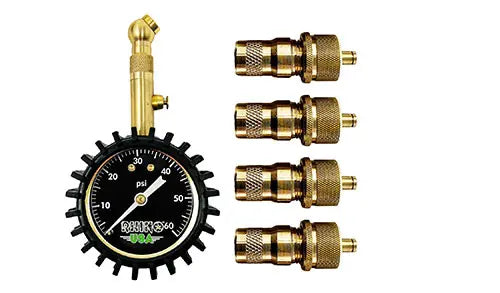
The Rhino USA 60 PSI Tire Pressure Gauge is the right pick for most car, motorcycle, and ATV owners.
75 PSI Gauges

A bridge between car and light-truck PSI. Useful for heavier trucks, light trailers, and SUVs where pressures run 35 to 65 PSI. The Rhino USA 75 PSI Tire Pressure Gauge covers trucks and trailers without sacrificing low-PSI accuracy.
100 PSI Gauges
For trucks, RVs, large trailers, and commercial applications. Most heavy-duty truck tires run 65 to 80 PSI loaded. RV tires run 60 to 110 PSI depending on size and load. The Rhino USA 100 PSI Tire Inflator Gauge reads the higher end without losing accuracy at lower pressures.
150 PSI Gauges

For commercial trucks, large RVs, and heavy-duty applications. Class A motorhomes with high-load tires can run 100 to 130 PSI. Commercial truck tires regularly hit 100+ PSI. The Rhino USA 150 PSI Digital Tire Gauge is the right call for these uses.
250 PSI Gauges

For commercial trucks, oversize tires, and bicycle/road bike applications where pressures hit 100 to 130 PSI. The Rhino USA 250 PSI Digital Tire Gauge covers the widest range, including high-pressure bike tires.
For users who want a gauge plus inflator in one tool, the Rhino USA 200 PSI Tire Inflator Gauge and Rhino USA 250 PSI Digital Inflator Gauge inflate from a compressor while reading pressure in real time.
What to Look for in the Best Tire Pressure Gauge
Six specs separate accurate, durable gauges from junk-drawer giveaways.
1. Accuracy
Look for gauges rated +/-1 PSI for digital or +/-2 PSI for analog. Cheap gauges drift to +/-3 PSI or worse, which is enough to show a properly inflated tire as overinflated and lead a user to bleed off real pressure.
2. PSI Range Match
Match the gauge range to your typical pressure measurements. A 250 PSI gauge used to read 32 PSI tires will be less accurate at the bottom of its range than a 60 PSI gauge reading the same tire.
3. Display Quality
For digital gauges, a backlit LCD with large numbers reads easier in low light, under a vehicle, or in bright sun. For analog dial gauges, a 2-inch or larger dial face with high-contrast printing is the right choice.
4. Build Material
Gauges live in glove boxes, tool drawers, and toolboxes. Metal-bodied gauges hold up. Plastic-bodied gauges crack. Look for chrome-plated brass or aluminum bodies, not all-plastic construction.
5. Air Bleed Valve
A bleed valve lets you let air out without removing the gauge. Useful when you're trying to hit a specific pressure exactly. Quality gauges include a bleed valve; cheap gauges skip it.
6. Hose vs Direct Read
Direct-read gauges press straight against the valve stem. Hose gauges have a flexible braided hose between the head and the gauge body. Hose gauges are easier to use on rear inner duals, recessed valves, and motorcycles. Direct-read gauges are smaller and faster for routine checks.
For most users, a hose gauge is the right call. The flexibility is worth the small extra size.
When to Choose Digital vs Analog

Digital advantages: Higher accuracy (+/-1 PSI typical), easier to read in low light (backlit), displays fractional PSI, and can include extra features like deflator buttons.
Digital trade-offs: Battery dependency, slightly more fragile if dropped repeatedly.
Analog advantages: No battery, simpler mechanical design, holds the highest reading for shop work.
Analog trade-offs: Lower accuracy than digital, harder to read in low light without illumination.
For most users, digital wins on accuracy and ease of reading. Analog dial gauges are the right call for shop work or users who don't want any battery dependency.
Tire Pressure Gauge Use by Vehicle Type
Different vehicles, different requirements.
Cars and SUVs
Most passenger cars run 30 to 40 PSI. A 60 or 75 PSI gauge with digital readout is the right call. Check pressure monthly and before long trips.
Trucks and Heavy-Duty Pickups
Trucks loaded for hauling or towing run higher pressures than empty trucks. The door jamb sticker shows the recommended PSI for typical loads. Loaded heavy-duty trucks can run 65 to 80 PSI. A 100 PSI gauge covers all common pickup uses.
Motorcycles
Motorcycle tires run 28 to 42 PSI typically. Underinflated motorcycle tires are dangerous because the soft sidewall changes handling. A 60 PSI gauge with a hose attachment makes it easy to reach motorcycle valves. Check before every ride.
RVs and Motorhomes
RV tires carry the most load and run the highest pressures of common vehicle classes. Class A motorhomes can run 100 to 130 PSI. A 150 PSI digital gauge or 100 PSI gauge covers most travel trailer and Class C use. Check before each travel day. RV tire blowouts are often pressure-related.
Off-Road and Overland
Off-road drivers air down to 12 to 25 PSI for sand, snow, mud, or rocks, then air back up to 30 to 35 PSI for highway travel. A 60 PSI gauge reads the low end accurately, and an inflator gauge combo speeds up the air-up step. Pair a gauge with a portable compressor for trail-side adjustment. For the full air-down/air-up workflow, see our Best Tire Deflator guide.
Bicycles and High-Pressure Tires
Road bike tires run 80 to 130 PSI. Mountain bike tires run 25 to 50 PSI. A 150 or 250 PSI gauge with the right valve fitting reads bike tires accurately. Some users keep separate gauges for bikes vs vehicles.
How to Read a Tire Pressure Gauge
The process is the same for all gauge types.
- Check pressure cold. Tires heat up after driving and pressure rises 4 to 6 PSI in 10 to 15 minutes. Read first thing in the morning or after the vehicle has sat for 3+ hours.
- Remove the valve cap. Unscrew the small black cap on the valve stem.
- Press the gauge firmly onto the valve. A short hiss is normal. A long hiss means the gauge is not seated. Press straight on, not at an angle.
- Hold for the reading. Digital gauges beep or display when stable. Analog gauges show the highest pressure registered and hold until reset.
- Compare to spec. The recommended PSI is on the door jamb sticker (driver-side door frame). Owner's manual is the backup.
- Adjust if needed. Add air at a gas-station or home compressor. Bleed air using the gauge bleed valve.
- Replace the valve cap. The cap keeps dust and debris out of the valve.
Common Features Worth Knowing
A few features that pay off in real use.
Lighted display. A backlit screen or illuminated dial reads in dark garages, under vehicles, and at the side of the road at night.
Built-in deflator. Some gauges include a button or stem that lets air out at a controlled rate. Useful for off-road air-down without removing the gauge.
Inflator combo. Pair a gauge with an inflator hose to a compressor and you can inflate while reading. Faster than alternating between separate tools.
Auto-off. Digital gauges with auto-off save battery life by shutting down after 30 to 60 seconds of inactivity.
Hold function. A digital gauge with a hold or freeze function locks the reading on the screen so you can read it after pulling the gauge from the valve. Useful in tight spaces.
Multi-unit display. Some gauges read PSI, kPa, bar, and kg/cm2. Useful for users who deal with both US and metric specifications.
Tire Pressure Gauge Calibration
Gauges drift over time. A calibrated gauge today may read 2 to 3 PSI off after a year of jostling in a glove box. Two ways to verify:
Compare against another gauge. Read the same tire with two different gauges. If both agree within 1 to 2 PSI, both are likely accurate. If they disagree by more, one or both is drifting.
Reference master gauge. Auto parts stores and tire shops can compare your gauge against a calibrated reference. Some gauges are user-calibratable with an offset adjustment.
For most users, replace the gauge if it drifts more than 3 PSI from a known-good reference. Quality digital gauges hold calibration for years; cheap pencil gauges drift fast.
Top Picks: Rhino USA Tire Pressure Gauges
Seven Rhino USA gauges cover the full PSI range from compact cars to heavy-duty trucks.
60 PSI Tire Pressure Gauge
The right pick for cars, motorcycles, ATVs, and most off-road air-down work. Direct-read gauge with a 2-inch glow-in-the-dark dial face, 45° angled tip with 360° swivel chuck, and solid brass construction. Backed by our lifetime warranty. Backed by our lifetime warranty.
75 PSI Tire Pressure Gauge
Hose-style gauge with a braided hose for easy access to recessed valve stems, a 2-inch glow-in-the-dark dial, solid brass hardware, and Presta adapter support for motorcycles. Covers trucks, light trailers, and SUVs running pressures up to 65 PSI. Same hose-style build as the 60 PSI version with extended range.
100 PSI Tire Inflator Gauge
For heavy-duty pickups, RVs, and large trailers. Reads the higher end of common vehicle pressures with full accuracy through the lower range.
150 PSI Digital Tire Gauge
Digital readout, backlit LCD, +/-1 PSI accuracy. The right pick for users who want the highest reading accuracy across the full PSI range.
250 PSI Digital Tire Gauge
For commercial trucks, oversize tires, and high-pressure bike tires. Widest PSI range in the lineup with full digital accuracy.
200 PSI Tire Inflator Gauge
Inflator gauge combo. Connects to a compressor and inflates while reading pressure in real time. The right call for users who inflate often, including off-road drivers airing back up after a trail day.
250 PSI Digital Inflator Gauge
Digital inflator gauge with the widest PSI range and highest accuracy. Pair with a portable compressor for trail-ready inflation.
For the full air-up/air-down workflow, pair any of these gauges with the Rhino USA 12V Dual Tire Air Compressor or the Dual Air Compressor + 4-Wheel Inflator Bundle.
Common Tire Pressure Gauge Mistakes
A few repeat offenders that cause bad readings or premature failure.
- Reading hot tires. Tire pressure rises 4 to 6 PSI after driving. Read cold tires for accurate baseline.
- Using a gauge near the top of its range. A 250 PSI gauge reading a 32 PSI tire is less accurate than a 60 PSI gauge reading the same tire. Match range to use.
- Ignoring the bleed valve. Adding air, then guessing how much to bleed off, costs more time than using the bleed valve.
- Skipping the door jamb sticker. The sticker shows the right pressure for the original tire size and vehicle weight. The number on the tire sidewall is the maximum pressure, not the recommended pressure.
- Letting the gauge live in extreme heat. A glove box at 140 degrees in summer shortens digital battery life and can damage internal sensors. Move to a cooler spot in summer.
- One gauge for life. Gauges drift. Replace at the first sign of inaccuracy or after 3 to 5 years of regular use.
Why Rhino USA Tire Pressure Gauges

Rhino USA is an American family operated business with three offices in the United States. Every tire pressure gauge in our lineup ships with a lifetime warranty. Real customer reviews on every product page run in the thousands at high ratings.
We build the gauges we'd carry in our own trucks, RVs, and off-road rigs. American family operated, lifetime warranty. If a Rhino gauge ever fails, we replace it.
FAQ
What is the best tire pressure gauge?
The Rhino USA 60 PSI Tire Pressure Gauge for cars and motorcycles, the 100 PSI for trucks and RVs, and the 150 PSI Digital for the highest accuracy across the full range. All ship with a lifetime warranty.
What is the most accurate tire pressure gauge?
Digital gauges rated +/-1 PSI are the most accurate option.
Are digital tire pressure gauges better than analog?
For accuracy, yes. For shop durability and no-battery operation, analog dial gauges still earn a place. Most modern users go digital.
What PSI rating do I need for my car?
Most passenger cars run 30 to 40 PSI. A 60 or 75 PSI gauge covers all common car uses with the most accurate reading.
Can I use a 250 PSI gauge on my car?
Yes, but a lower-range gauge will read more accurately on a 32 PSI tire. Match the range to your typical use.
How often should I check tire pressure?
Monthly minimum. Before any long trip. After major temperature swings (10+ degree drops can cause noticeable PSI loss).
What is the right tire pressure for my vehicle?
Check the door jamb sticker on the driver-side door frame. The owner's manual is the backup. The number on the tire sidewall is the maximum, not the recommended.
How do I read a tire pressure gauge?
Press the gauge head firmly onto the valve stem with the cap removed. Hold until the gauge stabilizes. Compare the reading to the door jamb spec.
Can I use one gauge for cars, trucks, and motorcycles?
Yes, if the gauge range covers all your tire pressures. A 100 PSI gauge handles cars (30 to 40 PSI), trucks (35 to 80 PSI), and motorcycles (28 to 42 PSI).
What's the difference between an inflator gauge and a regular gauge?
An inflator gauge connects to a compressor and inflates the tire while reading pressure in real time. A regular gauge just reads pressure.
Do RV tires need a special gauge?
RV tires often run higher pressures (60 to 130 PSI) than car tires. A 100 or 150 PSI gauge covers most RV use.
How long do tire pressure gauges last?
Quality digital gauges hold calibration for 3 to 5 years of normal use. Analog dial gauges can last longer if not dropped repeatedly. Replace any gauge that drifts.
Are inflator gauges worth it?
For frequent inflation use (RVs, off-road, fleets), yes. Save real time on every fill.
Do Rhino USA tire pressure gauges come with a warranty?
Yes. Lifetime warranty on every Rhino USA tire pressure gauge. American family operated.
Related Articles
- Best Tire Deflator for Off-Roading
- Best Tire Repair Kit: 2026 Buyer's Guide
- 10 Things to Check Before You Tow
- Best Gifts for Truck Guys
- Choosing a selection results in a full page refresh.