


Best Tire Deflator for Off-Roading: Air Down Faster
The best tire deflator hits your target tire pressure consistently across all four tires, doesn't make you stand at each wheel hand-pressing the valve, and packs into a case that fits in your console or recovery bag. Anyone who runs trails, sand, or snow already knows the rule: air down before you go in. Lower pressure on dirt, sand, mud, or a soft trail is the single most useful thing you can do before the wheels turn off pavement. The catch is that doing it right takes time, and the wrong tools turn a five-minute job into a half-hour pain.
This guide covers the three main types of tire deflators, what to look for in a quality kit, and the Rhino USA picks that live in our own trucks and UTVs. American family operated, lifetime warranty on every product.
Why Air Down for Off-Road
Lower tire pressures change how a tire behaves on loose surfaces. A deflated tire sits flatter, which spreads the vehicle's weight across more contact patch and gives the tread more bite. The result: better traction in sand and mud, smoother rides over washboard, fewer punctures because softer rubber conforms to sharp objects instead of pushing against them, and less trail erosion from wheelspin.
Common air-down ranges:
- Hard-pack dirt and gravel: 18 to 25 PSI
- Sand: 12 to 18 PSI
- Mud and snow: 12 to 20 PSI
- Rock crawling: 8 to 15 PSI (with beadlock wheels)
- Daily-driver street: factory spec on the driver's door jamb sticker (usually 30 to 40 PSI)
Hit the right pressure for the terrain. Don't guess. Don't eyeball it. Use the right tool.
The Three Types of Tire Deflators
There are three main styles of tire deflators. Each has its place.
1. Manual Tire Deflators

A manual deflator is the simplest tool. Unscrew the valve cap, thread the deflator onto the valve stem, depress the valve core, watch the built-in gauge, and stop when you hit your desired pressure. Manual deflators are accurate, but they require you to monitor the deflation process and stop the airflow yourself. That means standing at each tire, watching the gauge, hand-tuning each one. For a single tire it's fine. For four tires it adds up.
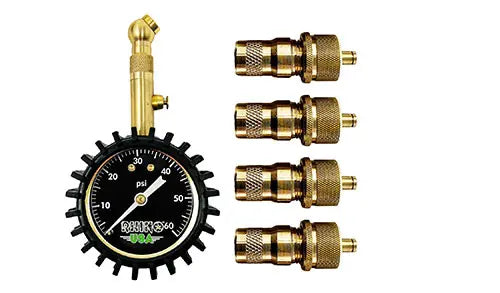
The Rhino USA Pro Tire Deflator Kit is a serious manual setup with a 60 PSI gauge, and the precision to dial in any target pressure across the full air-down range.
2. Automatic Tire Deflators

Automatic tire deflators are the speed answer. Set them to your target air pressure, screw one onto each valve stem, and walk away. The deflators stop automatically at the preset pressure. No standing, no watching.
With a four-pack, you deflate all four tires simultaneously while you check your gear, hook up your recovery rope, or grab a snack. Total time: about as long as one slow manual deflation, divided by four.
The Rhino USA 10-30 PSI Adjustable Tire Deflator Kit is the four-pack automatic kit, adjustable from 10 to 30 PSI to cover sand, trail, mud, and snow targets in one tool.
3. Valve Core Removal Deflators
A valve core removal deflator is the fastest method. The tool removes the valve core entirely, which lets air rush out at maximum flow. You hold a separate gauge against the valve to monitor pressure, then reinstall the valve core when you hit target.
Valve core removal is fast (45 seconds to a minute per tire) but requires constant attention and risks losing the valve core in the dirt while you're holding the valve open. For most off-roaders, the speed isn't worth the hassle. Automatic deflators are the better choice unless you're racing the clock.
What to Look for in the Best Tire Deflator

Whichever style you pick, the same quality features separate working tools from junk.
Accurate Pressure Gauge
The whole point is hitting a specific pressure. The gauge has to read accurately. Look for 1 PSI increments (not 5 PSI), calibrated analog or backlit digital gauges within +/-1 PSI, and a thick rubber housing to protect the gauge against drops on rocky trails. Battery-free analog gauges drift less than digital but can fail mechanically with hard impacts. Digital gauges hold accuracy longer but die when batteries fail. Pick the style you trust and verify it once a season.
Corrosion-Resistant Components
Off-road tools live in mud, salt, water, and grit. Solid brass and stainless steel hold up. Plastic valve caps and zinc-plated steel are fine for occasional use, but if you actually run trails, go brass.
Hose Quality
Flexible braided hoses reach valves on dual-rear-wheel trucks and tight angles. Braided is more durable and more flexible in extreme temperatures than standard rubber.
Carrying Case

A real case keeps your kit organized, protects the gauge, and means you actually have the tool when you need it. The cheap big-box deflators that ship in blister-packs disappear in your toolbox within a week.
How to Use a Tire Deflator Step by Step
For manual deflators:
- Unscrew the valve cap from one tire.
- Thread the deflator onto the valve stem.
- Pull the handle to depress the valve core and start releasing air.
- Watch the pressure gauge until it reads your target.
- Push the handle down to stop airflow.
- Unscrew the deflator and replace the valve cap.
- Repeat at each tire.
For automatic deflators:
- Preset each unit to your target pressure (rotate the cap to calibrate).
- Screw one onto each valve stem.
- Walk away. The deflator stops automatically at the preset pressure.
- Listen for the air to stop hissing, then unscrew each unit.
- Verify pressures with a pressure gauge.
For valve core removal:
- Unscrew the valve cap.
- Back out the valve core with the tool.
- Hold a pressure gauge against the open valve to monitor.
- Reinstall the valve core at target pressure.
Re-Inflating After the Trail
Airing down is half the job. Airing back up before you hit pavement is the other half. Driving on aired-down tires at highway speeds builds heat in the sidewall, damages the tire, and can cause a blowout.
A portable air compressor closes the loop. The Rhino USA 12V Dual Tire Air Compressor inflates two tires at once, which cuts your air-up time roughly in half compared to a single-head pump.
For groups and trailhead routines where speed matters most, the Rhino USA 4-Wheel Tire Inflation/Deflation System pairs with the 12V dual compressor to air up (and air down) all four tires simultaneously. The Dual Air Compressor + 4-Wheel Inflator Bundle ships both together for the full trailhead setup.
For a smaller solo kit, the Rhino USA 150 PSI Portable Tire Inflator covers single-vehicle inflation in a compact case.
The Rhino USA Tire Deflator and Gauge Lineup
Every Rhino USA product is American family operated and backed by lifetime warranty.
10-30 PSI Adjustable Tire Deflator Kit
Our flagship automatic deflator kit. Four units that screw onto your valve stems and stop automatically at the desired pressure. Adjustable from 10 to 30 PSI to cover sand, trail, mud, and snow. Set once, deploy at every trail. Includes carrying case.
Pro Tire Deflator Kit
Manual deflator with a 60 PSI gauge and braided hose. Built for serious off-roaders who want to fine-tune deflation and monitor every step for a consistent pressure across all four wheels.
60 PSI Tire Deflator Gauge
A combined gauge and deflator in one tool. Read pressure and bleed to target without swapping tools.
100 PSI Tire Inflator Gauge
Analog mechanical pressure gauge. Battery-free, shock-resistant, glow-in-the-dark face. Works as a backup to any deflator and as a quick check at every tire after airing down.
150 PSI Digital Tire Gauge
Digital readout in 0.1 PSI increments, backlit display, durable rubber bump guard. For riders who want maximum precision and the ability to see the gauge at night without a flashlight.
For the full gauge breakdown across the PSI range, see our Best Tire Pressure Gauge buyer's guide.
Tire Deflators vs Manual Pressure Reduction

A common question: is a tire deflator better than just airing down with the valve core or a key tool?
Yes, for a few reasons. A deflator's gauge is calibrated; a penny-and-a-key trick is not. Automatic deflators handle four tires simultaneously. A deflator stops at your target pressure; manual methods overshoot. Deflators don't lose the valve core in the dirt. The total time savings across a lifetime of trips is hours.
If you off-road more than once a year, the deflator pays for itself.
Setting Up Automatic Deflators the First Time
Automatic deflators ship preset to a default pressure, usually around 18 to 20 PSI. Before your first trip, calibrate each unit to your target trail pressure.
- Note your factory street pressure for each tire.
- Decide your trail target (15 PSI for most sand and trail, 12 PSI for deeper mud or snow).
- Air down one tire manually to your trail target.
- Screw an automatic deflator onto that valve stem and rotate the cap to lock the trigger point.
- Repeat for each unit so all four match the same trail target.
- Pack the kit in the carrying case.
After the first calibration, run the kit at every trailhead without re-setting unless you want a different target. Some riders carry two sets calibrated to different pressures (one for sand, one for trails) so they don't have to recalibrate between terrain types.
Trail Etiquette: Airing Down at the Trailhead
Air down before you hit the trail, not in the parking lot. Find a spot off the main staging area where you're not blocking other riders. Pull all four units out of the case, screw them onto the valve stems, and use the time to gear up, hook up recovery gear, or grab a snack. The deflators do the work while you do everything else.
When the air stops hissing, check pressures with a gauge to verify, unscrew each unit, and reinstall the valve caps. Total time: about as long as one slow manual deflation, but for all four tires.
Maintenance: Keeping Your Deflator Working
A tire deflator is a precision tool. Keep it working by:
- Storing it in the carrying case to protect the gauge and threads.
- Cleaning grit out of the threaded valve fitting after dusty trips.
- Lubricating the screw threads occasionally with light silicone grease.
- Verifying calibration once a season against a trusted gauge.
Quality units last for years. Bargain-bin deflators tend to drift in calibration after a few months.
How Pressure Gauge Accuracy Impacts Real Trail Use
Two riders standing at the same tire with different gauges will read different pressures. That's normal. The real question is whether your gauge reads accurately enough to hit your target. Most riders can run within 1 to 2 PSI of target without performance differences. Drift past 3 to 4 PSI and the truck handles or rides differently than expected.
Verify your gauge once a season against a known-good reference. If it's off by more than 2 PSI consistently, replace it.
Why Rhino USA for Tire Deflators

Three reasons our deflators live in trucks, Jeeps, and UTVs across the country:
- Lifetime warranty. If anything ever fails, we replace it. No paperwork. No hassle.
- American family operated. Real people behind every order. Phone-answered customer service, straightforward warranty replacements, and a team that stands behind its gear.
- Verified reviews from real users. Thousands of reviews per product at 4.4 to 4.9 stars.
FAQ
What is the best tire deflator?
The Rhino USA 10-30 PSI Adjustable Tire Deflator Kit for automatic four-tire air-down, and the Rhino USA Pro Tire Deflator Kit for manual precision. Both ship with carrying cases and a lifetime warranty.
What is a tire deflator?
A tool that releases air from a tire to lower its pressure to a specific target, usually for off-road driving on sand, mud, snow, or rocks.
Is a tire deflator better than airing down manually?
Yes. Faster, more accurate, and more consistent across all four tires. Automatic deflators stop at your target pressure so you don't overshoot.
Should I air down before going off-road?
Yes. Lower tire pressure increases the contact patch, improves traction on loose surfaces, smooths the ride over washboard, and reduces the chance of punctures. Air back up before highway driving.
What PSI should I air down to?
18 to 25 PSI for hard-pack dirt and gravel. 12 to 18 PSI for sand. 12 to 20 PSI for mud and snow. 8 to 15 PSI for rock crawling with beadlock wheels.
Is it safe to fully deflate a tire?
Don't fully deflate while the tire is on the rim and you're driving. Running on a fully flat tire damages the sidewall and the rim, and the tire can unseat from the bead.
Can you drive with tire deflators on?
No. Deflators are for stationary deflation. Remove them before driving.
How do I air back up after the trail?
Use a portable 12V air compressor like the Rhino USA 12V Dual Tire Air Compressor. For four-tire air-up at once, pair it with the Rhino USA 4-Wheel Tire Inflation/Deflation System.
Do automatic tire deflators work?
Yes. Set them to a target pressure, screw them onto each valve stem, and walk away. The unit stops the airflow at the preset pressure.
Are Rhino USA tire deflators backed by a warranty?
Yes. Lifetime warranty on every Rhino USA tire deflator. American family operated, real customer service, real warranty replacements.
Related Articles
- Best Tire Pressure Gauge: 2026 Buyer's Guide
- Best Tire Repair Kit: 2026 Buyer's Guide
- 10 Things to Check Before You Tow
- Best Gifts for Jeep Owners
- Choosing a selection results in a full page refresh.