




How to Tow a Trailer: A Complete Beginner’s Guide to Your First Tow
|
Key Takeaways
|
Knowing how to tow a trailer starts well before you turn the key. For most beginners, the scary part isn't steering or backing up. It's not knowing whether the setup is safe before pulling out of the driveway. Can your vehicle pull this trailer? How much can you load in it? How much weight should sit on the hitch? Is the cargo secured well enough for the highway?
This guide covers what you can pull, how to connect it, how to load it, how to secure what's on it, and how to drive it. One idea runs through all of it: almost every towing problem is a weight problem that started before the vehicle moved. Get the numbers and the connections right first, and the drive gets a lot easier.
The Five Numbers That Decide What You Can Tow
Before you worry about brakes, backing up, or ball sizes, learn five ratings and measurements. Ford's towing guide defines GVWR, GCWR, GAWR, and tongue weight, and the same ideas apply to any make.
|
Term |
What It Means |
Where to Find It |
|---|---|---|
|
GVWR (gross vehicle weight rating) |
The maximum the loaded tow vehicle may weigh |
Door-jamb label |
|
GCWR (gross combined weight rating) |
The maximum for the tow vehicle and trailer together |
Owner's manual or the maker's towing guide |
|
GAWR (gross axle weight rating) |
The maximum weight on a single axle |
Door-jamb label |
|
GTW (gross trailer weight) |
What the loaded trailer actually weighs |
A scale, not a guess |
|
TW (tongue weight) |
The downward force the coupler puts on the hitch ball |
A scale under the trailer tongue |
The advertised or empty weight of a trailer isn't the number that counts. Add camping gear, tools, fuel, water, coolers, and everything else you're hauling, and the real weight climbs fast.
Tongue weight matters because it changes how the whole rig handles. Chevrolet's trailering guide puts it at 10–15% of the total loaded trailer weight for a conventional trailer and 15–25% for a gooseneck or fifth-wheel trailer. Consumer Reports gives the same 10–15% range for conventional trailers.
Work Out Your Real Towing Capacity
The maximum tow rating in the brochure isn't necessarily what you can pull today. Start with the published tow rating, then subtract anything it doesn’t assume: extra passengers, gear in the bed, and the hitch itself. Then check payload separately, because tongue weight counts against payload, not the tow rating.
Here's a worked example with round numbers. Say a half-ton pickup is rated to tow 9,000 pounds, and its door-jamb label lists 1,800 pounds of payload.
|
Step |
Weight |
Payload Remaining |
|---|---|---|
|
Payload from the door-jamb label |
1,800 lbs |
|
|
Four passengers at about 175 lbs |
-700 lbs |
1,100 lbs |
|
Loaded bed |
-300 lbs |
800 lbs |
|
Hitch hardware |
-50 lbs |
750 lbs |
That leaves 750 pounds for tongue weight. A 700-pound tongue weight fits, and at 10%, it corresponds to a trailer of about 7,000 pounds, or about 4,700 pounds at 15%. Either way, you're already under the 9,000 pounds on the brochure. These figures are made up to show the method, so pull your own from your vehicle's label and manual. You'll also need to check the combined weight against GCWR.
Then add a safety margin. Edmunds recommends staying at least 10% under the maximum rating, and its worked example caps a 6,500-pound rating at 5,200 pounds, which is 80%. Neither number is a regulation. For a first tow, the 80% figure makes sense: 80% of 9,000 pounds is 7,200. Use whichever limit comes out lowest.
One rule governs the whole system: the weakest link in the towing chain determines the capacity, up to the vehicle manufacturer's limits. Everything from the hitch back, including the ball mount, ball, coupler, pins, and chains, carries its own rating, and the smallest number wins.
The Equipment You Need, and How the Parts Connect

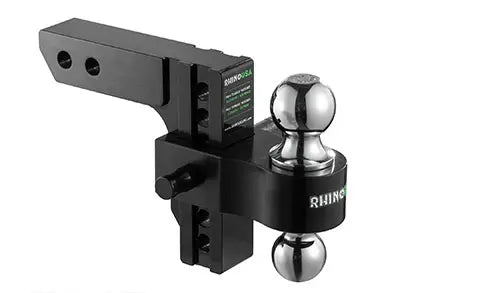
Working from the vehicle back: the receiver is the square opening on the tow vehicle. A ball mount slides into it, and a hitch pin with a retaining clip holds it there. The hitch ball bolts to the ball mount, and the coupler on the trailer tongue locks over the ball.
Receiver hitches are grouped into Classes I through V. Rhino's guide to trailer hitch types lists the ceilings below. Manufacturers publish different figures, so the rating on your own hitch is the one that counts.
|
Class |
Gross Trailer Weight, up to |
Receiver Size |
|---|---|---|
|
I and II |
2,000 to 3,500 lbs |
1-1/4 in |
|
III and IV |
8,000 to 10,000 lbs |
2 in |
|
V |
20,000 lbs |
2 in or 2-1/2 in |
Receiver size and ball size cause a lot of confusion. Ford lists three ball sizes: 1-7/8, 2, and 2-5/16 inches, and Rhino notes that the coupler is stamped with the ball size it requires. The 1-1/4, 2, and 2-1/2 inch measurements describe receiver openings. Rhino's receiver size guide covers them in detail.
Before you tow, check every connection by hand instead of by eye. A ball that looks close enough isn't. The ball, coupler, receiver, ball mount, and pin must be compatible and rated for the load.
Hitching Up, Step by Step

Slow down here. A few minutes of checking beats dealing with a trailer that comes loose.
Step 1: Back Up and Lower the Coupler onto the Ball
Line the ball up under the coupler. Use a spotter if you have one; if you're alone, get out and check the alignment instead of guessing the last few inches from the seat. Then lower the coupler all the way onto the ball with the trailer jack.
Step 2: Latch the Coupler and Fit the Safety Pin
Close and lock the coupler latch, then slide the safety pin or lock through it so the latch can't work loose. Look at the connection before you raise the jack the rest of the way.
Step 3: Cross the Safety Chains under the Coupler
Attach the chains to the tow vehicle and cross them underneath the trailer tongue. Chevrolet's guide says to cross the chains under the tongue so the tongue is less likely to drop, and California's DMV handbook adds that they need enough slack to allow unrestricted turning. Keep the hooks facing inward with the latches closed. Choose chains strong enough for the trailer: federal rules for commercial vehicles require an ultimate strength of not less than the gross weight of the vehicle being towed, which is a sensible benchmark for any trailer.
Step 4: Connect the Wiring and the Breakaway Cable
Plug in the wiring and test the running lights, brake lights, and turn signals before you move. If the trailer has brakes, connect the breakaway cable to the tow vehicle. Keep it off the hitch head and out of the safety chains, and don't share an attachment point with a chain. Breakaway rules vary by state. Virginia requires an emergency breakaway system on braked trailers over 3,000 pounds gross weight, while California's DMV handbook says breakaway switches are required for any trailer with a gross weight of 1,500 pounds or more, so check your state's rule.
Step 5: Torque Check
The hitch ball carries the whole connection, so install it properly. Tighten the ball nut to the torque specified for your ball, which is printed on its packaging or instructions. Rhino's pre-tow checklist lists a ball nut torqued to spec as a check to make every trip. Recheck the nut after your first tow, and inspect the rest of your trailer hitch hardware while you're at it.
Loading the Trailer: Where the Weight Goes
The total weight is half the job. Where it sits is the other half. A common starting point is the 60/40 rule. Ford's guide says approximately 60% of the cargo weight belongs in the front half of the trailer and 40% in the rear. Chevrolet gives the same guidance and adds that the load should be spread evenly from side to side.
The reasoning is simple. The trailer needs enough tongue weight to stay stable behind the vehicle. A U.S. government towing brochure from NHTSA warns that too little tongue weight can cause the trailer to sway, and too much can leave too little weight on the tow vehicle's front wheels.
Keep heavy items low and don't stack them high. Ford's guide says to keep the center of gravity low for best handling, and tall, top-heavy loads raise it.
The 60/40 rule is a starting point, so measure your tongue weight instead of trusting it. Ford's guide says to disconnect the trailer and place only the tongue on a scale at hitch-ball height. For a heavy trailer or an important load, weigh the whole rig at a certified scale; Consumer Reports notes this usually costs about $10. Moving cargo changes the balance, so recheck after you load anything heavy at the back. Load it, check it, then secure it.
Securing the Load on the Trailer
A trailer can match the tow vehicle perfectly and still be dangerous if the cargo isn't secured. Your straps and tie-downs need real strength, and that means reading the right number on the label.
Working Load Limit vs. Break Strength
Break strength is the force at which a strap fails. Working load limit (WLL) is the most it's meant to carry in normal use. For synthetic web tie-downs, the standard is a minimum 3:1 design factor, which puts the WLL at about one-third of break strength. Use the WLL, not the break strength, to judge your setup.
How Much Combined Strength You Need
Federal cargo-securement rules give a benchmark: the aggregate WLL of the tie-downs must be at least one-half the weight of the cargo (49 CFR 393.106(d)). Those rules apply to commercial motor vehicles in interstate commerce, as FMCSA explains, and they're not written for weekend hauling. They're still a sound benchmark for private trailers, and your state's rules still apply.
The same section says how to count each strap. A strap running from a vehicle anchor to the cargo counts half its WLL. A strap that goes over the cargo and returns to the same side of the vehicle also counts half. A strap that runs from one side, over the cargo, to an anchor on the other side counts its full WLL.
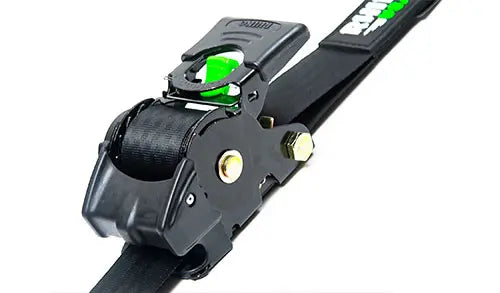
Say you're securing an 1,800-pound load. Half is 900 pounds, so the straps need a combined WLL of at least 900. Three straps rated 300 pounds each, run over the load and anchored on both sides, add up to exactly 900. If they only ran from the trailer to the cargo, each would count half, and you'd need six. With Rhino's 2-inch retractable ratchet straps, rated at 1,011 pounds WLL and 3,033 pounds break strength, two straps anchored on both sides clear the weight rule for the same load.
Anchor points are part of the system. Under 49 CFR 393.108(a), a tie-down's WLL is the lowest of any of its components or the anchor point it attaches to. A 1,100-pound strap on a 250-pound anchor is a 250-pound connection.
How Many Tie-Downs You Need
The federal rules also set minimum counts. For cargo not blocked against forward movement, 49 CFR 393.110(b) calls for one tie-down for an article 5 feet or shorter and 1,100 pounds or lighter. It calls for two if the article is 5 feet or shorter and heavier than 1,100 pounds, or if it's between 5 and 10 feet long. Beyond 10 feet, it's two tie-downs plus one more for each additional 10 feet or fraction of it.
Those are minimums. Add tie-downs when the shape, weight, or center of gravity of the load calls for them. Once it's strapped down, walk around it. Check that straps aren't twisted or rubbing on sharp edges, hooks are seated, ratchets are locked, and nothing can shift, roll, or slide. For a fuller walkthrough, use Rhino's load securement checklist.
Driving with a Trailer

Everything takes longer with a trailer behind you. You accelerate more slowly, brake over a greater distance, and need more room to turn. Leave more following distance than usual. California's DMV handbook advises a three-second or greater following distance, and Chevrolet's guide suggests one vehicle-and-trailer length for every 10 mph.
Make Wider Turns
A trailer doesn't follow the exact path of the tow vehicle. NHTSA's brochure explains that because the trailer's wheels track closer to the inside of a turn, you should make wider turns at curves and corners to avoid curbs. Swing wider than feels necessary and watch the trailer in your mirrors.
Understand Trailer Sway
Sway starts when the trailer swings from side to side behind you. Poor weight distribution, crosswinds, passing trucks, sudden steering, and speed can all set it off. Your instinct may be to fight it with the wheel. Don't. NHTSA advises that when wind or passing vehicles set off sway, you release the accelerator and keep a firm grip on the steering wheel. Ford adds that if you have electric brakes and a brake controller, you should activate the trailer brakes by hand and avoid the tow vehicle brakes, which can increase sway.
If sway happens repeatedly, stop and find the cause. Check the load distribution, tongue weight, tire pressures, and hitch connections before you continue.
Practice Reversing
Backing up gets easier with practice. Rhino's guide to backing up a trailer starts with a simple trick: place your right hand at the bottom of the steering wheel, the 6 o'clock position, for more intuitive control. Remember that in reverse, the trailer goes the opposite way from the wheel. Make small inputs, go slowly, and get out to look if you're unsure what's behind you.
Watch Your Speed and the Conditions
The speed limit isn't automatically the right speed with a trailer. Maxxis recommends not exceeding 65 mph when towing a trailer, so read your tire sidewall and follow the tire maker's guidance. Some states cap towing speeds, too. California, for example, limits a passenger vehicle drawing another vehicle to 55 mph under Vehicle Code 22406. Check the rules on your route.
Crosswinds, mountain passes, and passing trucks all push a trailer around. On hills, add following distance and expect your brakes to work harder on the way down. The rougher the conditions, the more margin you should give yourself.
Pre-Departure Checklist
Before every trip, walk around the vehicle and trailer. Rhino's pre-tow checklist goes deeper, and this is the short version.
Hitch and Connections
-
Coupler seated, latched, and pinned
-
Safety chains crossed, attached, and properly rated
-
Breakaway cable connected to the tow vehicle
-
Ball nut torqued to spec, and receiver pin and clip installed
Vehicle and Trailer
-
Trailer lights tested
-
Tire pressures checked on the vehicle and the trailer
-
Mirrors adjusted
-
Trailer brakes and brake controller checked, if equipped
Load
-
Cargo balanced, with about 60% in the front half of the trailer as a starting point
-
Heavy items low and everything strapped down
-
Combined tie-down WLL at least half the cargo weight, on anchors that can take it
-
Nothing loose in the bed or on the trailer
Once you're moving, check again early. Edmunds suggests double-checking the trailer's connections and your cargo after a mile or so and checking securing straps periodically. Look at the straps, coupler, chains, tires, and overall load every time.
Your First Tow Starts Before the Engine Does
Towing well isn't about memorizing a long list of rules. It's about a few things that matter most and habits that build around them. Know what your vehicle can tow and what the trailer weighs loaded. Keep the tongue weight in range, connect the hitch carefully, and balance the cargo. Strap everything down with tie-downs and anchors rated for the load, then give yourself extra room and patience.
Your first tow may feel strange for the first few miles. That's normal. After a while, you'll feel how the trailer moves, how wide to take a turn, and how early to brake. Prepare carefully, secure the load, and leave yourself some margin, and the campsite, the trailhead, or the boat ramp is waiting at the other end.
FAQs
How much can I tow?
You can tow only what the lowest-rated part of your setup allows. Check your vehicle's tow rating, GVWR, GCWR, and GAWR, then subtract passengers, cargo, hitch equipment, and tongue weight. The loaded trailer's actual weight is the number that matters, not its empty or advertised weight.
What is the 80% rule when towing?
The 80% rule is a conservative guideline, not a regulation. It says to keep the loaded trailer at or below about 80% of your vehicle's rated towing capacity. Edmunds recommends staying at least 10% under the maximum, and its example applies an 80% limit. For a first tow, the lower figure gives more margin.
How much tongue weight should a trailer have?
For a conventional trailer, aim for 10 to 15% of the loaded trailer weight, and never exceed the hitch or vehicle rating. Gooseneck and fifth-wheel trailers run higher, at 15 to 25%. Too little invites sway, and too much overloads the rear of the tow vehicle. Measure it instead of estimating.
How many straps do I need to secure a load on a trailer?
It depends on the cargo's length and weight. Federal rules set minimum tie-down counts, and the combined working load limit must be at least half the cargo weight. Use extra tie-downs when the load's shape, weight, or tendency to shift calls for them, and check that the anchor points are strong enough.
Do I need to torque the hitch ball nut?
Yes. Tighten it to the torque specified for your ball, which is usually printed on the packaging or in the instructions, and don't guess. A loose ball nut puts the whole connection at risk. Recheck the nut after your first tow, and make it part of your pre-trip walk-around.
What causes trailer sway and how do I stop it?
Too little tongue weight, poor load distribution, speed, crosswinds, and sudden steering can all cause sway. If it starts, ease off the accelerator, hold the wheel steady, and apply the trailer brakes by hand with the controller if you have one. Don't apply the tow vehicle's brakes or steer sharply.
How fast can you drive while towing?
It depends on your trailer tires, tow vehicle, road, and local law. Maxxis recommends not exceeding 65 mph when towing a trailer, and some states set lower limits for vehicles towing trailers. Check your tire sidewall and the rules where you're driving, then slow down for wind, hills, and traffic.
- Choosing a selection results in a full page refresh.