



Adjustable Drop Hitches: How to Calculate the Drop You Actually Need
|
Key Takeaways
|
If your trailer rides nose-high or nose-low when you hook it up, the hitch height is probably off, and that changes how the rig brakes, wears its tires, and handles sway.
The fix is usually a drop hitch, a ball mount that holds the ball below the receiver opening, and choosing one takes two measurements. Measure the receiver height, measure the coupler height, and subtract. The difference is the drop you need.
The calculator below does the subtraction and points you to a size. If you'd rather learn the full method first, start with Rhino's walkthrough on how to measure hitch drop. This page adds the calculator, sizing references, a lifted-truck example, and the capacity checks to make before you buy.
What a Drop Hitch Does, and Why Level Matters

A drop hitch is a ball mount whose ball platform sits below the receiver opening. It brings the trailer level when the tow vehicle's receiver sits higher than the trailer's coupler.
Towing out of level is a handling problem, not a cosmetic one. Rhino USA's guide to trailer hitch types says a nose-up or nose-down trailer brakes badly and wears tires unevenly. Vehicle makers ask for the same result: Ford's towing guide says to adjust the tongue jack until the trailer is level or just slightly nose down.
How to Measure for Drop or Rise
Take each measurement in inches and write it down as you go.
Step 1: Park the Vehicle and Trailer on Level Ground
A sloped driveway is the most common source of an incorrect measurement, because it changes both heights at once.
Step 2: Measure from the Ground to the Top of the Receiver Opening
Use the top inside edge of the receiver opening. Skip the bottom of the bumper and the center of the tube.
Step 3: Measure from the Ground to the Bottom of the Coupler
Use the tongue jack to bring the trailer level first. If you can't tell by eye, lay a small torpedo level on a straight section of the trailer frame. Then measure to the bottom of the coupler.
Step 4: Subtract
Receiver height minus coupler height. Positive is drop, negative is rise. With a 23-inch receiver and a 17-inch coupler, you need a 6-inch drop.
Step 5: Measure Loaded, Not Empty
This step is the easiest to forget. Tongue weight and bed cargo press the rear suspension down, which changes the receiver height. Rhino's measuring guide says that for maximum accuracy, you should measure the trailer with the expected tongue weight or loaded to its normal towing weight. If you measured empty, recheck once the loaded trailer is connected.
Drop Hitch Sizes and What Each Suits
Drop hitches are sold in a range of lengths, and the right one depends on the gap between your receiver and coupler.
|
Drop Size |
Typical Setup |
Ground Clearance |
|---|---|---|
|
2 in |
Small height differences |
Minimal added impact |
|
4 in |
Moderate differences |
Generally modest |
|
6 in |
Common truck and trailer pairings; many stock half-ton trucks land at 4 to 6 in |
Check steep transitions |
|
8 in |
Larger differences and some lifted trucks |
Departure angle matters more |
|
10 in |
Bigger lifts and large receiver-to-coupler gaps |
Check ramps, driveways, and off-road transitions |
A deeper drop puts the ball lower under the receiver, so clearance matters more. A hitch that clears a flat road can scrape on a steep driveway or a ramp. Ball size comes from your coupler, not the drop: the common diameters are 1-7/8, 2, and 2-5/16 inches, and the coupler is stamped with the size it needs. Shopping by receiver size? Rhino's guide to receiver sizes explains which is which.
Treat all of this as a starting point. Tire size, suspension changes, payload, tongue weight, and trailer design still move the number.
Drop Needed by Vehicle Type

Receiver height changes with the model, hitch, tires, suspension, and load, and manufacturers don't publish one figure for a vehicle class. Rhino's guide to receiver sizes says that for most stock half-ton trucks, a 4–6-inch drop puts a typical travel trailer level. That's a reasonable first guess, and your tape measure is the final word.
Lifted Trucks: Working the Math End to End
Lifted trucks are where the receiver-minus-coupler sum earns its keep. Take a half-ton pickup with a 21-inch stock receiver height and a 17-inch trailer coupler. A 35-inch tire is about 3 inches taller than a typical 32-inch stock tire (a 265/70R17 measures 31.6 inches), and that lifts the axle and the receiver by about 1.5 inches.
|
Setup |
Receiver Height |
Drop Needed (17 in Coupler) |
|---|---|---|
|
Stock |
21 in |
4 in |
|
2-inch lift |
23 in |
6 in |
|
4-inch lift |
25 in |
8 in |
|
4-inch lift and 35-inch tires (+1.5 in) |
26.5 in |
9.5 in |
The last row is the full sum: 21 + 4 + 1.5 - 17 = 9.5 inches of drop, before any change from loading the truck.
What if the number is bigger than anything on the shelf? You can buy a specialty mount with a longer drop, raise the trailer's coupler if the trailer allows it, or accept a compromise on level. Each option costs you something: the specialty mount adds price and reduces clearance, a raised coupler means modifying the trailer, and a compromise gives up some handling. Measure the truck as it sits rather than estimating from the lift alone, because the receiver may not have moved by the full lift height.
Why Capacity Depends on the Specific Mount
Every ball mount carries its own rating, set by its weakest part: the shank, the ball, the welds, and the fit in the receiver. Your hitch class doesn't transfer that rating either. Rhino's guide to hitch types points out that bolting a Class V hitch onto a Class III truck does not give you Class V capacity, because the truck's tow rating is the ceiling.
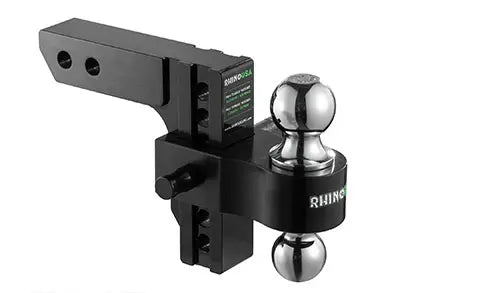
Ratings also move with the design. Rhino's adjustable drop hitch for 2-inch receivers is rated for 12,500 pounds of trailer weight and 1,250 pounds of tongue weight, while the 2.5-inch receiver version is rated for 18,500 pounds and 1,850 pounds.
The rule to follow: use the capacity listed for the specific ball mount, at the specific drop, with the specific ball. Stay inside the lowest rating in the chain, whether that is the mount, the hitch, or the truck.
Adjustable vs. Fixed Drop Hitches
|
Aspect |
Fixed Drop Hitch |
Adjustable Drop Hitch |
|---|---|---|
|
Height adjustment |
One fixed position |
Adjustable within a range set by the model |
|
Multiple trailers |
Usually needs another mount |
One mount can fit different coupler heights |
|
Moving parts and play |
Fewer, less chance of rattle |
More, so it can move or rattle |
|
Weight |
Often lighter |
Often heavier |
|
Price |
Usually lower |
Usually higher |
|
Best for |
One consistent towing setup |
Multiple trailers or a changing setup |
A fixed mount wins on simplicity. It has fewer parts, usually weighs less, usually costs less, and has no adjustment channel to work loose.
An adjustable mount wins on flexibility. One hitch can serve several trailers, and it absorbs a change of tow vehicle or a future lift. The trade-off is play, so install it snugly and add an anti-rattle tightener if it clicks or rattles. Rhino's guide to stopping hitch rattle covers the fix. For a longer comparison, see the ultimate guide to heavy-duty adjustable drop hitches.
Setting Up After You Have the Right Drop

Getting the height right is half the job. The other half is a hitch that is torqued, pinned, and checked.
Install the Ball Correctly
Match the ball diameter to the size stamped on the coupler. Then torque the ball nut to the spec for your ball, using the figure printed on its packaging. Rhino's pre-tow checklist lists the ball nut torqued to spec and a mount free of corrosion and cracks as checks to make before every trip.
Pin the Mount in the Receiver
Slide the mount all the way in, line up the holes, and insert the pin with its clip, or use a locking pin. Rhino's receiver guide lists a 5/8-inch pin for a 2-inch receiver. With an adjustable mount, also confirm the adjustment holes are fully aligned, and the hardware is engaged before you connect the trailer.
Connect and Check
Lower the coupler onto the ball, latch it, and cross the safety chains underneath. Then plug in the wiring and test the lights. Rhino's pre-tow checklist covers the rest. Before you pull out, step back and look at the rig: the trailer should sit close to level with clearance under the ball mount.
Recheck After the First Tow
Recheck the ball nut, pin, adjustment hardware, and coupler latch after your first trip, then again whenever you change trailers or the hitch position.
Get the Drop Right the First Time
The calculation is short: receiver height minus coupler height equals the drop you need. Measure loaded, pick the closest size, then check the mount's rating and your ground clearance.
An adjustable drop hitch earns its keep if you tow more than one trailer or expect your setup to change. Rhino USA's adjustable drop hitch for 2-inch receivers comes in 6-, 8-, and 10-inch drops with 2-inch and 2-5/16-inch balls and two locking hitch pins. It is rated for up to 12,500 pounds of trailer weight and 1,250 pounds of tongue weight. The 2.5-inch receiver version is rated for 18,500 pounds and 1,850 pounds.
Shop Rhino USA adjustable drop hitches.
FAQs
How much drop does my hitch need?
Measure from the ground to the top of the receiver opening, then from the ground to the bottom of the level trailer coupler. Subtract the coupler height from the receiver height. A positive result is the drop you need. A negative result means you need a rise. Round to the nearest size sold.
How do I measure hitch drop on a lifted truck?
Measure the truck's actual receiver height instead of estimating from the lift. Take it from the ground to the top of the receiver opening, measure your level trailer's coupler, and subtract. Lift height, tire diameter, payload, and tongue weight all change the result, so measure with the truck loaded as you tow.
Does a drop hitch reduce towing capacity?
Each ball mount has its own rating, set by its weakest part, and the lowest-rated component in your setup sets the limit. Check the rating published for your exact mount, drop length, and ball size, then compare it with your truck's tow rating and tongue weight rating before you tow.
Can you flip a drop hitch to get a rise?
Some ball mounts can be flipped, such as Rhino USA’s, but not every model is designed for it. If your coupler sits higher than your receiver, you need a rise, so check the manufacturer's instructions and ratings for your part number before you flip the mount. Never assume a drop hitch is rated for the rise position.
How level does a trailer need to be?
Aim for a trailer frame that sits parallel to the ground. Ford's towing guide says to adjust the tongue jack until the trailer is level or just slightly nose down. If yours sits clearly nose-up or nose-down, recheck your measurements and hitch height before you tow.
What is the standard trailer coupler height?
There isn't one number that fits every trailer. Coupler height depends on the axle, tires, tongue design, and load, so measure yours with the trailer level instead of assuming a figure. Then subtract it from your receiver height to find the drop or rise you need.
Should I measure with the trailer loaded or empty?
Measure the way you'll tow. Rhino's measuring guide recommends measuring the trailer with the expected tongue weight, or loaded to its normal towing weight. Tongue weight and cargo press the rear suspension down and change the receiver height, so recheck once the loaded trailer is connected.
- Choosing a selection results in a full page refresh.